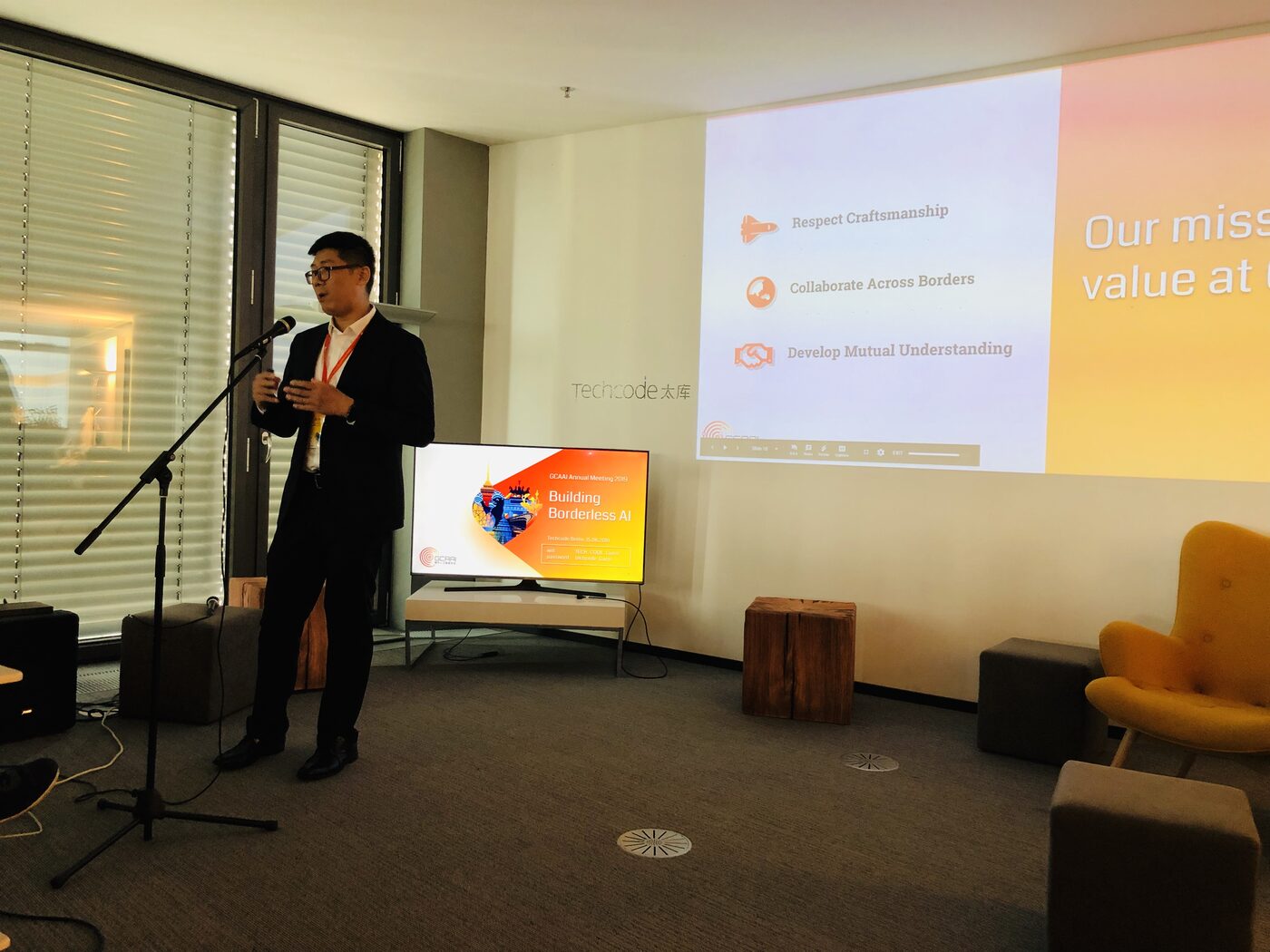
The case for borderless AI at GCAAI's annual meeting in Berlin
On 15 June 2019 deepkapha.ai spoke at the GCAAI annual meeting at Techcode Berlin, arguing that AI built across borders beats AI built behind national walls.
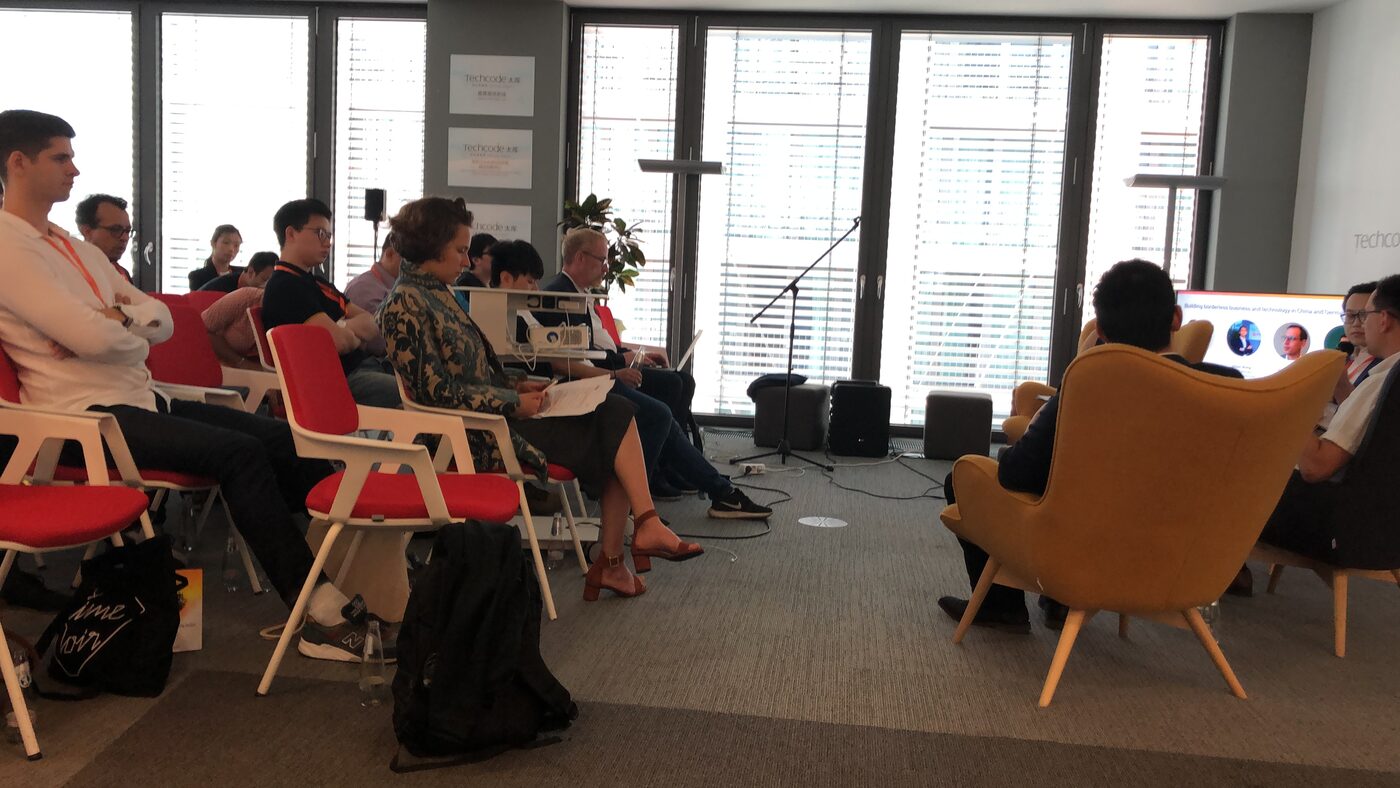
The GCAAI Annual Meeting 2019 ran at Techcode's Berlin office on 15 June, under the banner "Building Borderless AI". Tarry Singh came in by train from Assen the day before. The room was a working office lounge: red and white chairs in rows, a projector on a low stand, Techcode signage on the glass partitions. A few dozen people sat through a morning of short talks and a panel on building borderless business and technology in China and Germany.
deepkapha.ai opened with its own position. More than 24,500 professionals trained by mid-2019, against a stated goal of 100,000 by the end of that year. Then came the groundwork. What separates machine learning from deep learning, written out as equations rather than adjectives. Where deep learning was already working: driving, diagnosis, translation, trading. Running underneath was a five-plateau model of company maturity, from fundamentals in maths, statistics and engineering, through data visualisation, machine learning and deep learning, up to applied AI.
The case for borderless AI was made against the arms-race framing. Nation states were writing surveillance laws, or being accused of ignoring them, and the worry on offer was that self-restraint would cost a country the lead. The talk pushed back on that. AI is not the Manhattan Project. It needs no national programme and no state budget, because a researcher anywhere can pick up open-source tools and join a global community working the same problem. One slide named the other risk directly, surveillance capitalism, and the wealth built from predicting and shaping behaviour.
The proof offered was client work. With the healthcare division of GOPA, deepkapha.ai built a breast-cancer classifier for a setting where pathologists and oncologists are scarce, aimed at women in Afghanistan. The images sat in a client portal, badly organised, annotated by German pathologists in a form no model could read. The team restructured the data, then trained convolutional networks with transfer learning in PyTorch, TensorFlow, Keras and fast.ai. A four-month pilot reached roughly 82 percent test accuracy on a very small dataset. The deck reported 98.5 percent a month before Berlin. Two shorter stories followed: an AI hackathon in Iraq earlier in 2019, and retinopathy screening in Guangzhou taken from idea to a working appliance.