The agentic mesh, put to a telco board
A keynote in Dubai for a large global telco with Central Asian operations, arguing that agentic AI is an operations problem rather than a content one.
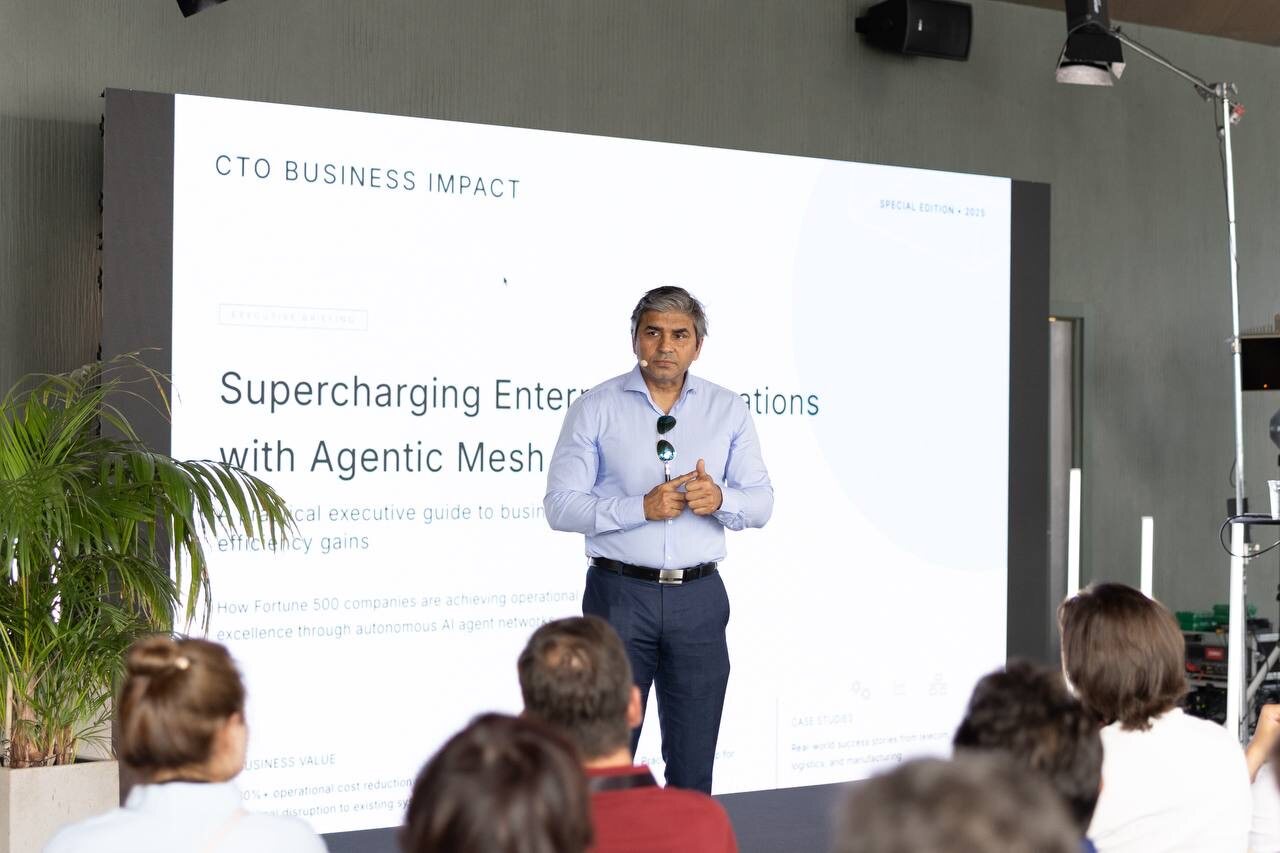
The deck is filed as DKAI Research, issue 14, July 2025, enterprise edition. Its subject is the agentic mesh, and its audience is named on the cover: CTO business impact. It was delivered as a keynote to a large global telco with Central Asian operations.
The argument opens by separating two things the market had been calling the same thing. Generative AI is reactive and content-shaped: one prompt, one response. Agentic AI is proactive and process-shaped, planning and executing across systems and teams to reach a goal. The mesh is what you get when those agents stop working alone. A registry that catalogues which agents exist and what they can do, the way HR holds skills. A protected channel between them, the way corporate email is protected. A governance layer that sets permissions and boundaries, the way company policy does. An orchestrator that assigns work and watches it land.
Against traditional automation the case is made on three properties rather than on speed. Rule-based automation follows pre-defined paths and breaks when an exception arrives; a mesh reasons around it. Rule-based automation lives inside one system; a mesh works across departments and data sources. Rule-based automation needs re-engineering whenever the process changes; a mesh learns from outcomes.
Then the numbers, all of them attributed on the slides to named implementations rather than to the lab. Document intake, validation and routing cut from three to five days down to seventeen minutes, error rates from twelve per cent to under one. Network operations with mean time to resolution down forty-two per cent. A telecom provider taking thirty per cent out of operational cost inside ninety days without a service interruption. A logistics operator saving more than three hundred million dollars a year by re-cutting routes twenty-two thousand times a minute.
The closing third is deliberately unglamorous, and it is the part a CTO actually buys. A twelve to eighteen month road map that starts with one or two low-risk processes and three to five agents, not a platform. Investment bands from a pilot at a hundred and fifty to three hundred thousand dollars up to a full deployment at two to five million, with average breakeven at 9.2 months. A build-or-partner comparison that puts in-house capability at twelve to eighteen months of hiring against sixty to ninety days with a partner. And a list of ways it goes wrong: automating everything at once, deploying agents with no trust boundaries, treating it as a technology programme rather than a change one. The advice against the first of those is a sentence any operator would recognise. Begin with the twenty per cent of processes that carry eighty per cent of the volume.