← THE FIELD RECORD
ELEVEN ENGINEERS, TWO DAYS

AI development in practice, Helsinki

6–7 June 2018 · Helsinki, Finland · LAB

Eleven engineers spent two days in a Helsinki classroom, moving from the history of the perceptron to a TensorFlow model served in production.
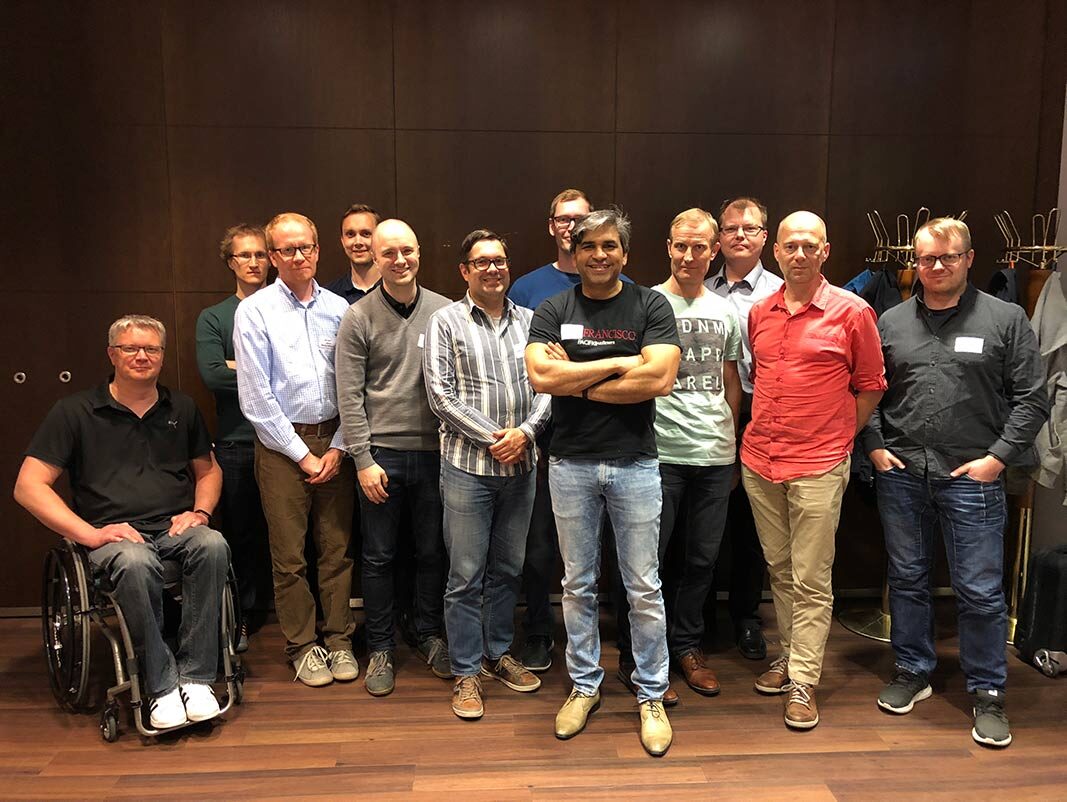
Closing group photograph of the Helsinki cohort, twelve people including Tarry Singh against a wood-panelled wall, several wearing Ari Hovi name badges.

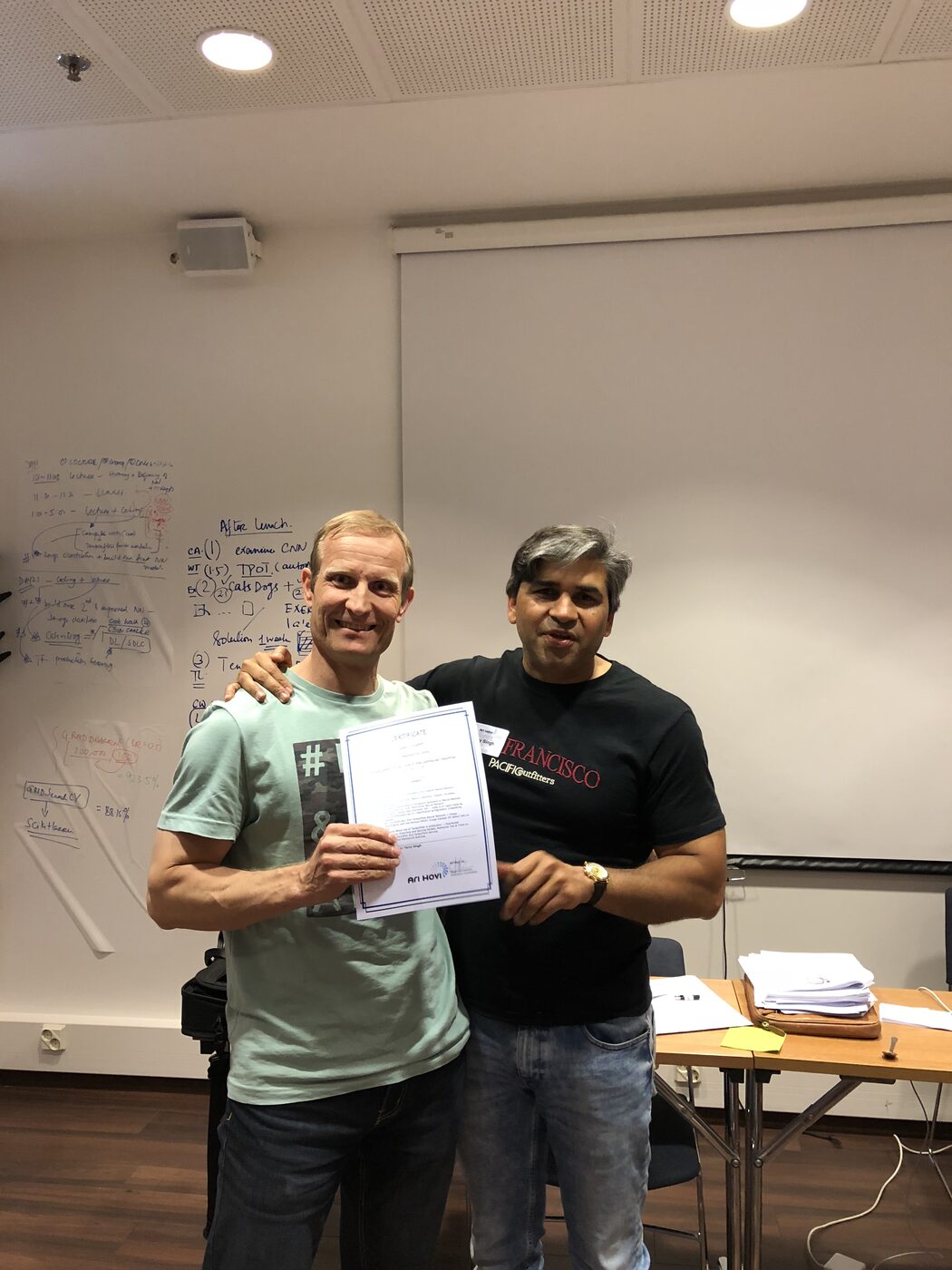
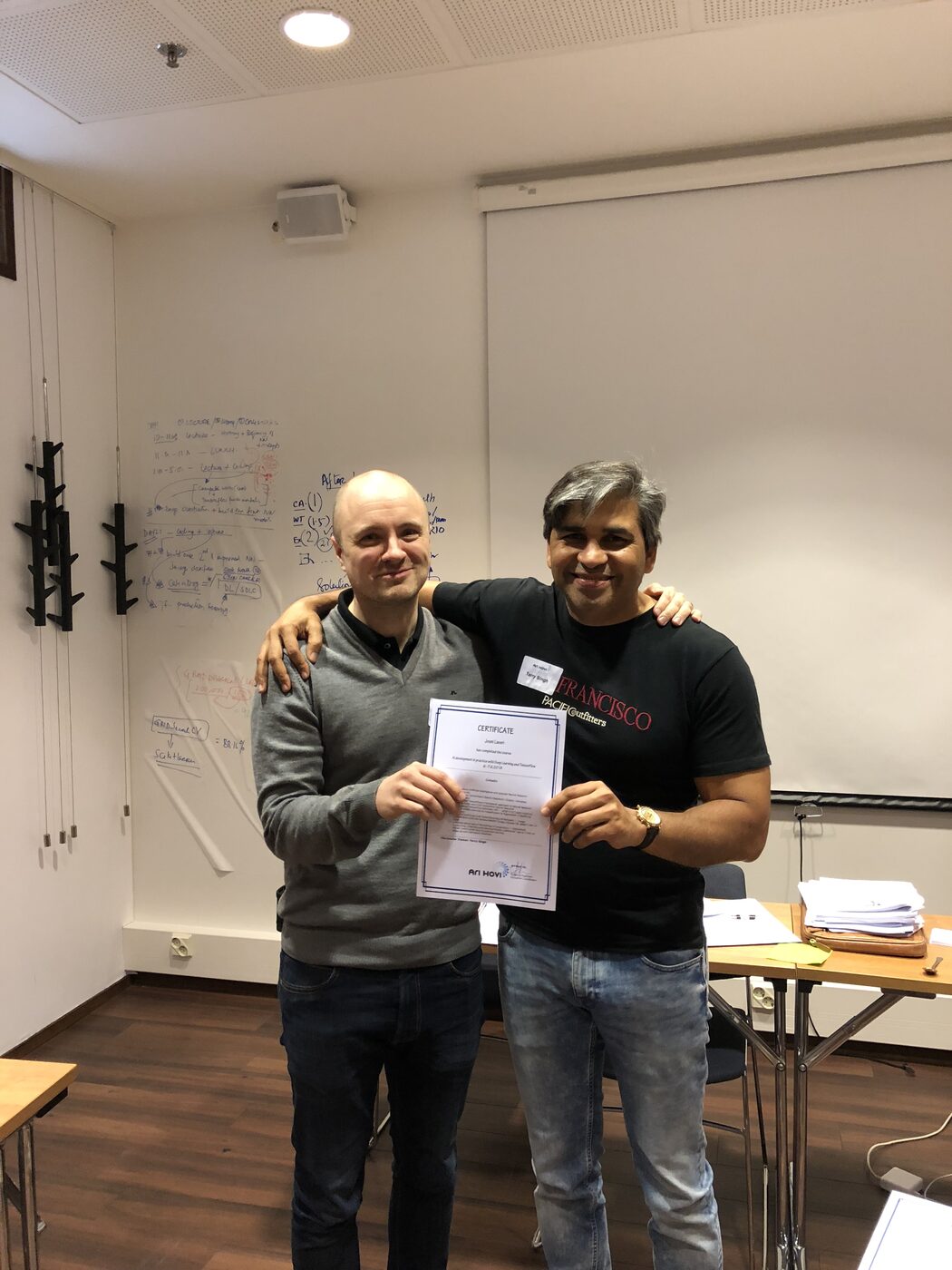
On 6 and 7 June 2018 deepkapha.ai ran a two day open course in central Helsinki for Ari Hovi Oy, the Finnish data and analytics training house. The course was titled "AI development in practice with Deep Learning and TensorFlow". Eleven engineers completed it. Eleven certificates were handed over one at a time on the afternoon of the second day, in front of the whiteboard the group had been working against since the first morning.

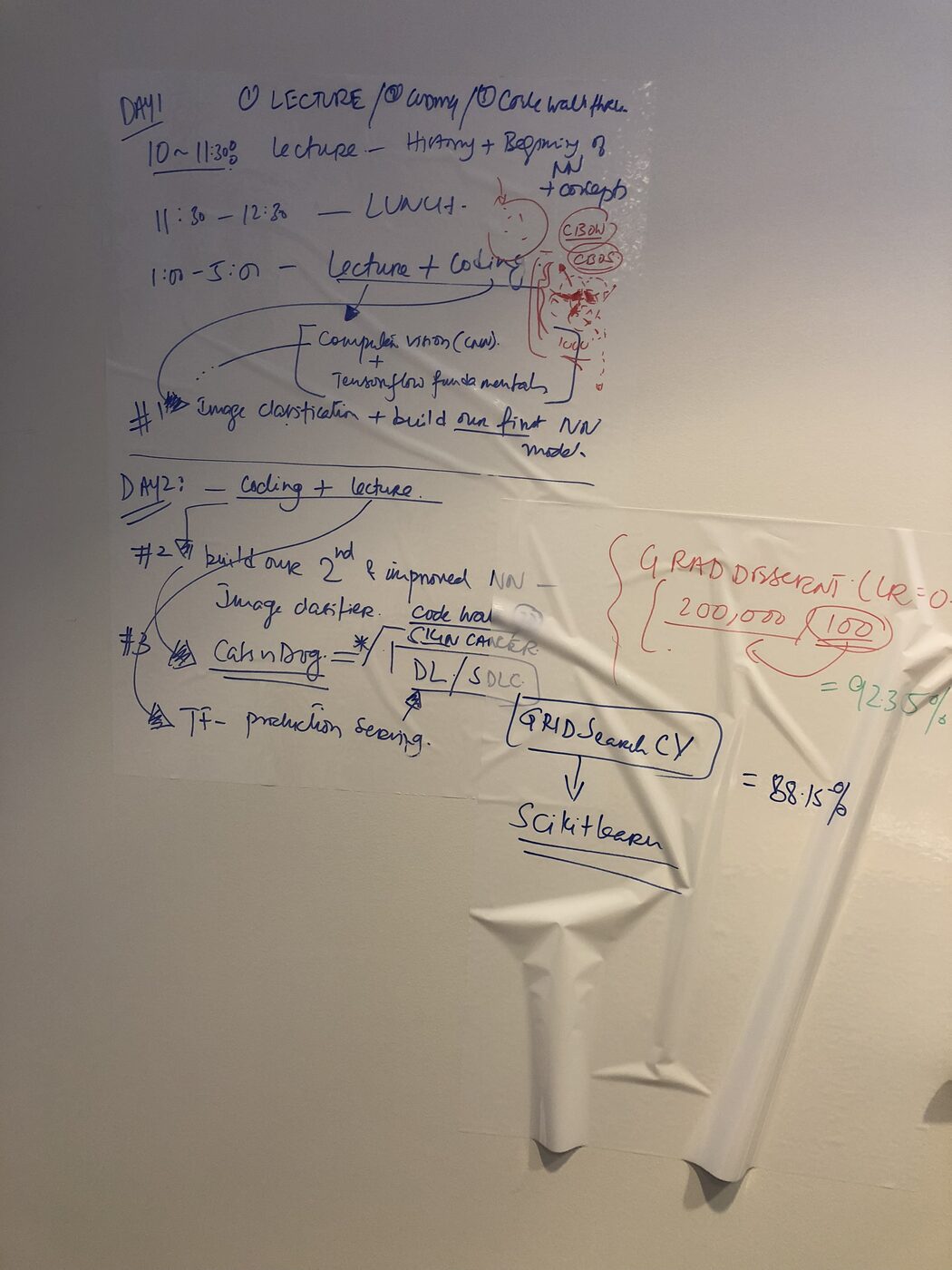
The timetable went up on that whiteboard on day one and stayed there. Lecture from 10:00 to 11:30 on the history and beginnings of neural networks. Lunch until 12:30. Then lecture and coding until 17:00: computer vision, convolutional networks, TensorFlow fundamentals, and the room's first working model, applied to image classification. Day two was coding first and lecture second. A second and improved network, an image classifier, a cats versus dogs walkthrough, a skin cancer model, then TensorFlow prediction serving and grid search cross validation in scikit-learn.

The teaching deck ran to 84 slides and was blunt about method. It covered neurons and activation functions, cost functions, gradient descent and backpropagation, then told the room it would code all of that manually in Python, with no deep learning library, before touching TensorFlow at all. The stated reason was that TensorFlow's syntax has direct connections to those same concepts, so building them by hand first makes the framework readable instead of opaque.

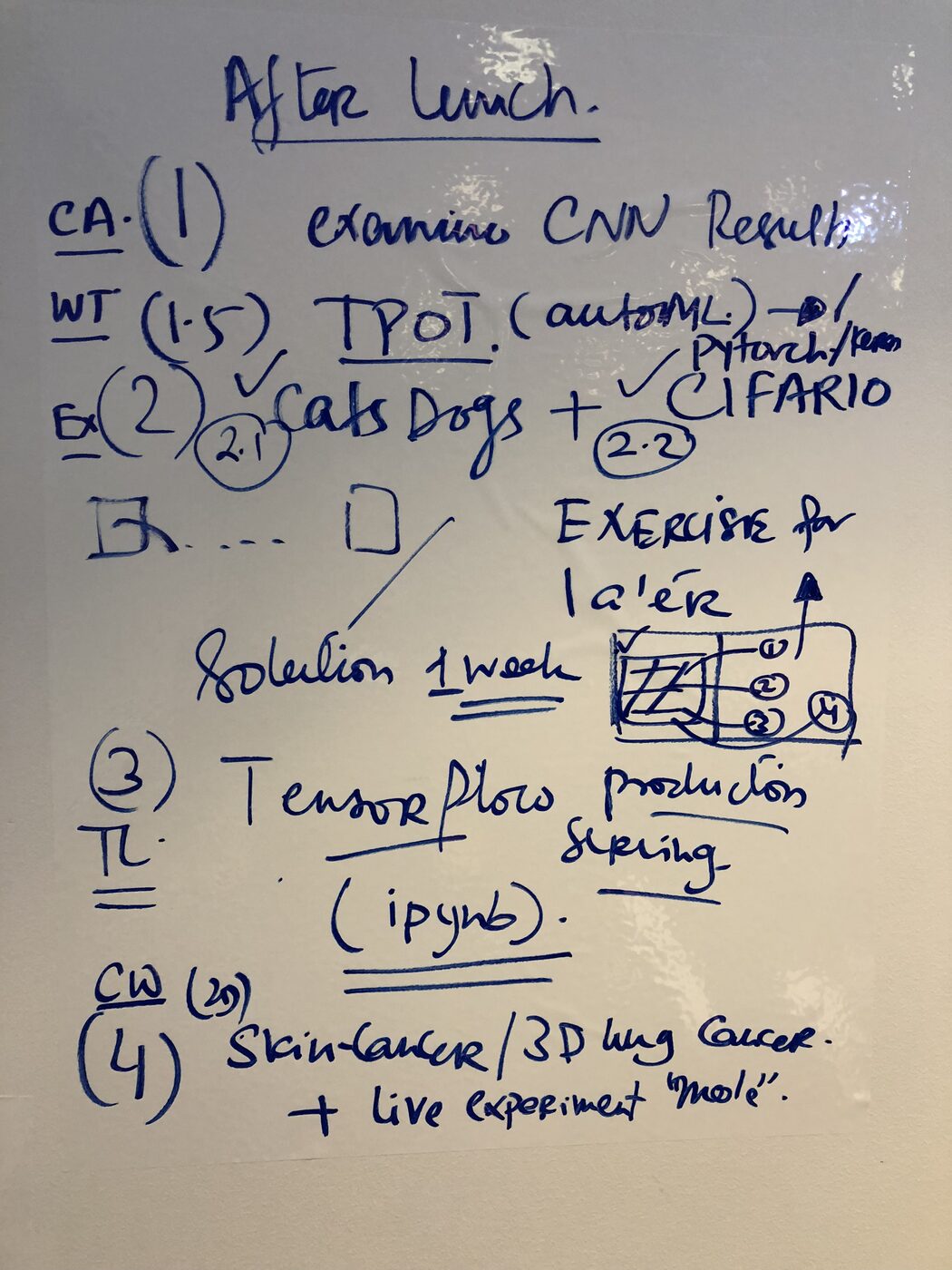
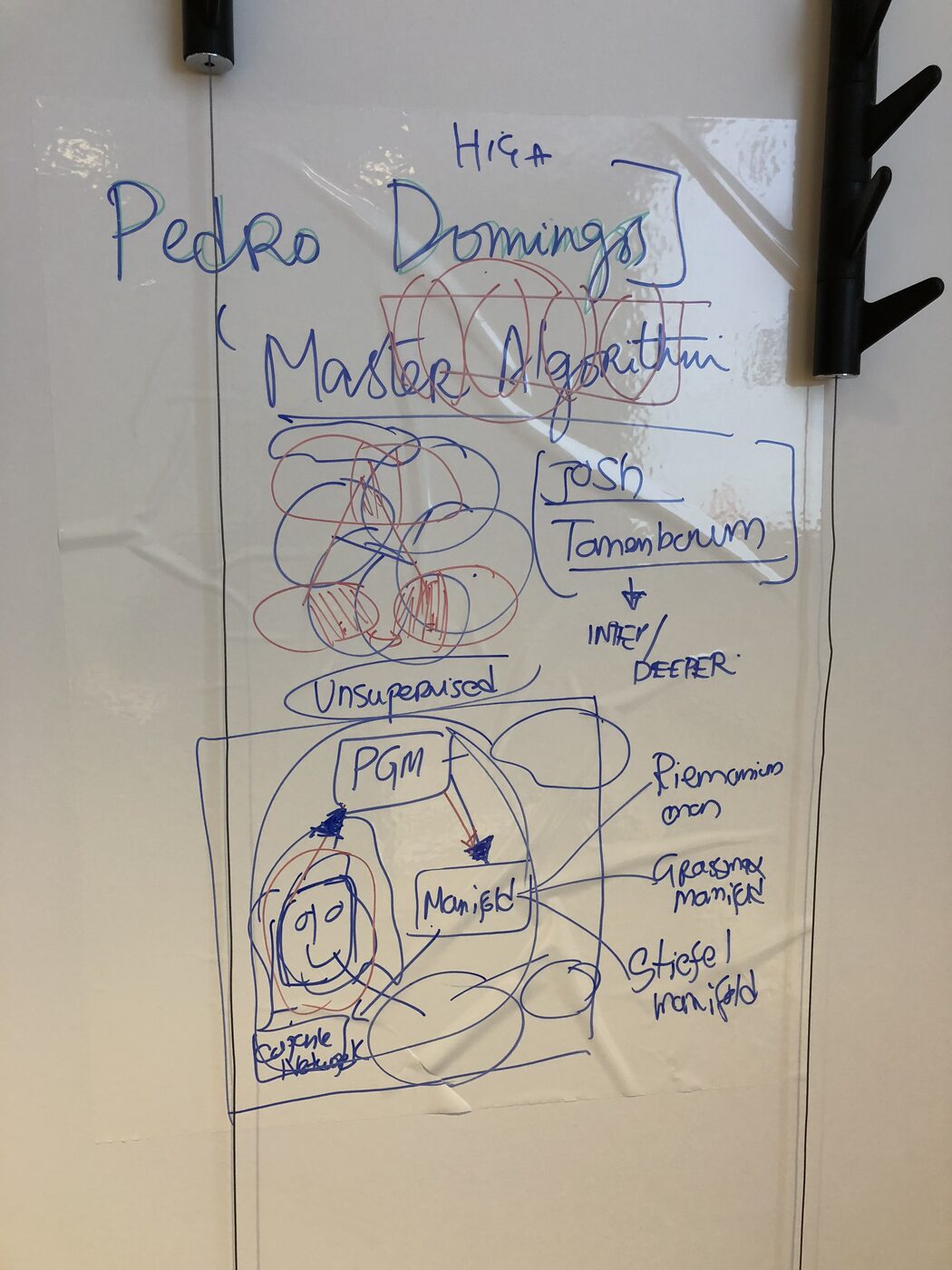
The second whiteboard, filled in after lunch on day two, shows where the room actually went. TPOT for automated machine learning, weighed against PyTorch and Keras. Cats and dogs, then CIFAR-10. TensorFlow production and serving worked through in a notebook. Skin cancer and 3D lung cancer, with a live experiment running a photograph of a mole against the model. An exercise was set to be taken away, with the solution promised in a week. A flip chart from the first afternoon carries a separate thread that ran from Pedro Domingos and The Master Algorithm out through unsupervised learning, probabilistic graphical models and manifolds.
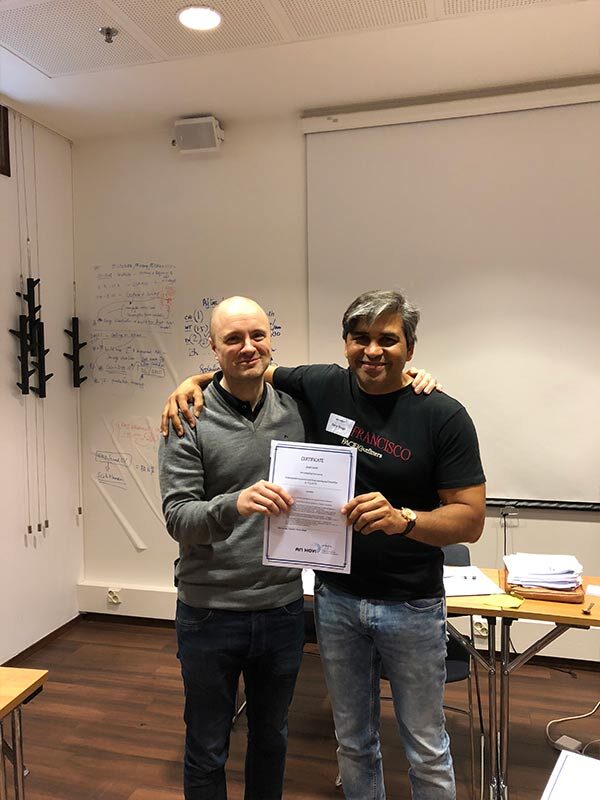
The date and the host are printed on the certificate. The venue is named nowhere in the material, so no building is claimed.

FROM THE FIELD · 07 FRAMES
Tarry Singh hands a course certificate to a participant. The certificate reads AI development in practice with Deep Learning and TensorFlow, 6.-7.6.2018, above the Ari Hovi Oy mark, with the two-day agenda whiteboard behind them.
The workshop whiteboard carrying the two-day timetable: day one lecture on the history and beginnings of neural networks, lunch, then lecture and coding until 17:00; day two coding, a second improved network, cats and dogs, skin cancer, TensorFlow prediction serving and grid search cross validation with scikit-learn.
Whiteboard notes from the afternoon of day two, listing CNN results, TPOT for automated machine learning alongside PyTorch and Keras, cats and dogs, CIFAR-10, TensorFlow production and serving in a notebook, and skin cancer and 3D lung cancer with a live mole experiment.
A participant receives his certificate, the two-day agenda still written up on the whiteboard behind.
Another certificate handover at the close of the second day, in front of the working whiteboard.
A flip chart from the workshop floor tracing an argument from Pedro Domingos and The Master Algorithm through unsupervised learning, probabilistic graphical models, manifolds and Bayesian networks.
WITH
Ari Hovi Oy
← EARLIERDeep learning bioinformatics at Mærsk TårnetLATER →Hult Prize Foundation, London