ARiA and LAYGo at NAVER Labs Europe
Two pieces of the lab's own research, the ARiA activation function and the LAYGo learning-rate controller, presented to researchers at NAVER Labs Europe.
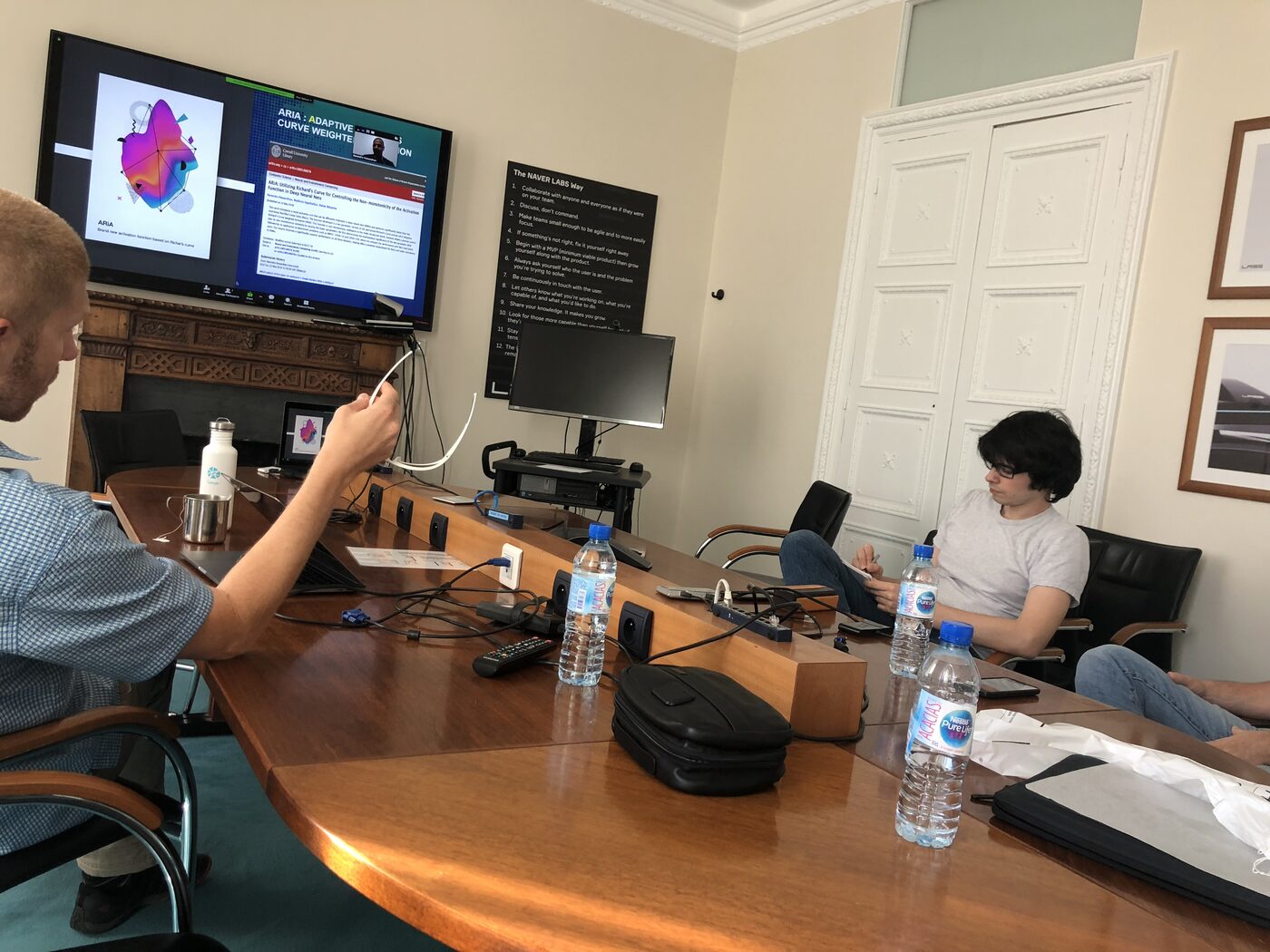
NAVER Labs Europe, the Grenoble research centre of the Korean technology group NAVER, arranged the visit itself. A car from Geneva airport on 24 October, two nights in Grenoble, dinner with the hosts on the evening of arrival, and a pick-up back from the lab at 17:00 on the 25th. The session ran in a small panelled meeting room with a wall-mounted screen and a laptop on the conference table. On the wall beside the screen hung a printed copy of The NAVER LABS Way, twelve working principles that open with "Collaborate with anyone and everyone as if they were on your team."
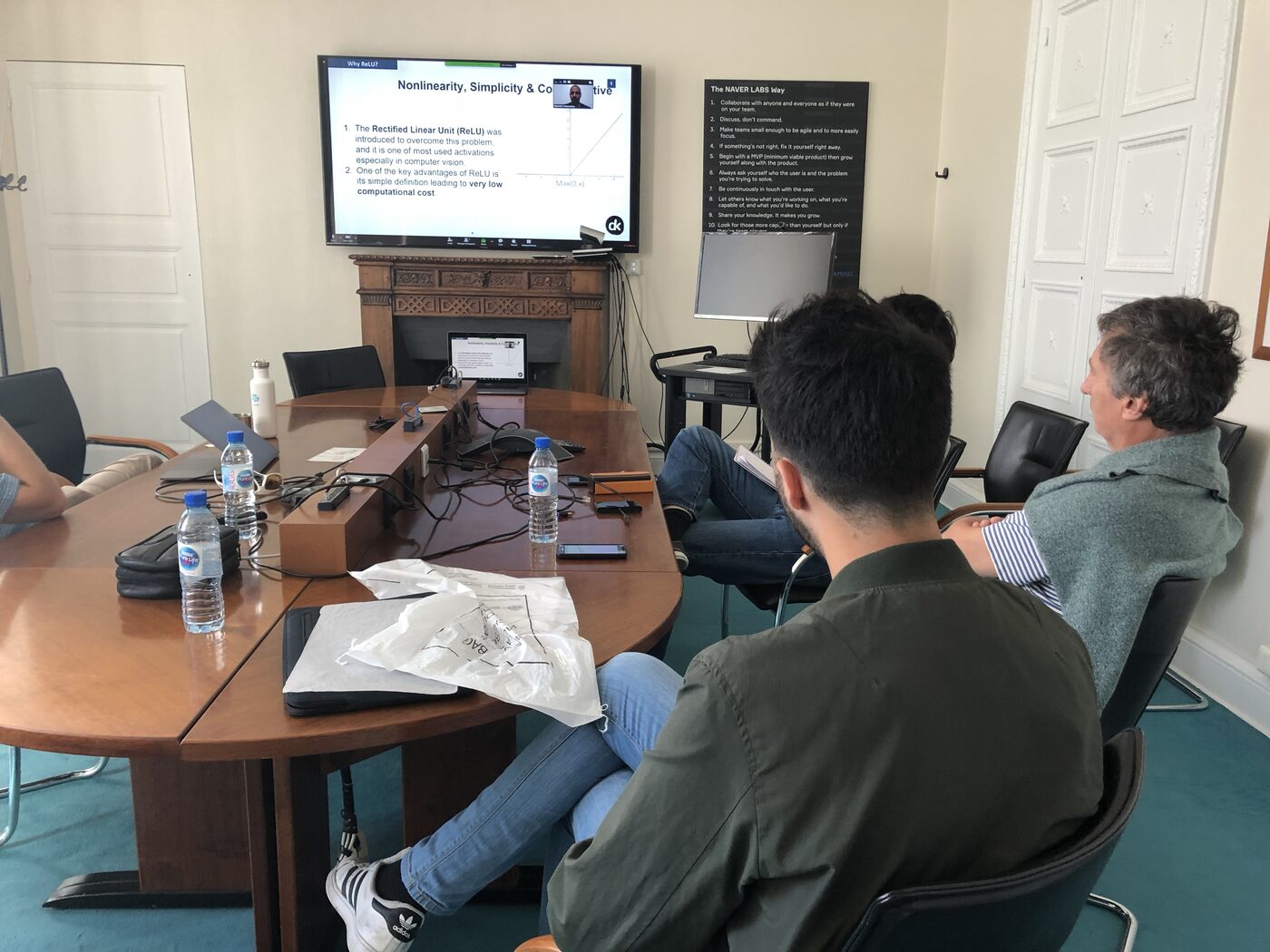
The first half of the thirty-slide deck was ARiA, short for Adaptive Richard's Curve Weighted Activation. The argument started outside machine learning entirely, in the Richards growth function published in the Journal of Experimental Botany in 1959 and used since to model maize leaf area, forestry yield and predator-prey growth. Richards' curve carries enough degrees of freedom that multiplying it by the pre-activation gives precise control over the shape of the activation, and both ReLU and Swish fall out as special cases. The reduced two-parameter version, ARiA2, was tested on MNIST, CIFAR-10 and CIFAR-100 across a range of architectures, depths, optimisers and batch sizes, and outperformed Swish and ReLU in each configuration. The underlying paper, arXiv:1805.08878, was submitted on 22 May 2018 by Narendra Patwardhan, Madhura Ingalhalikar and Rahee Walambe. Patwardhan joined the room by video call and is visible in the participant tile.
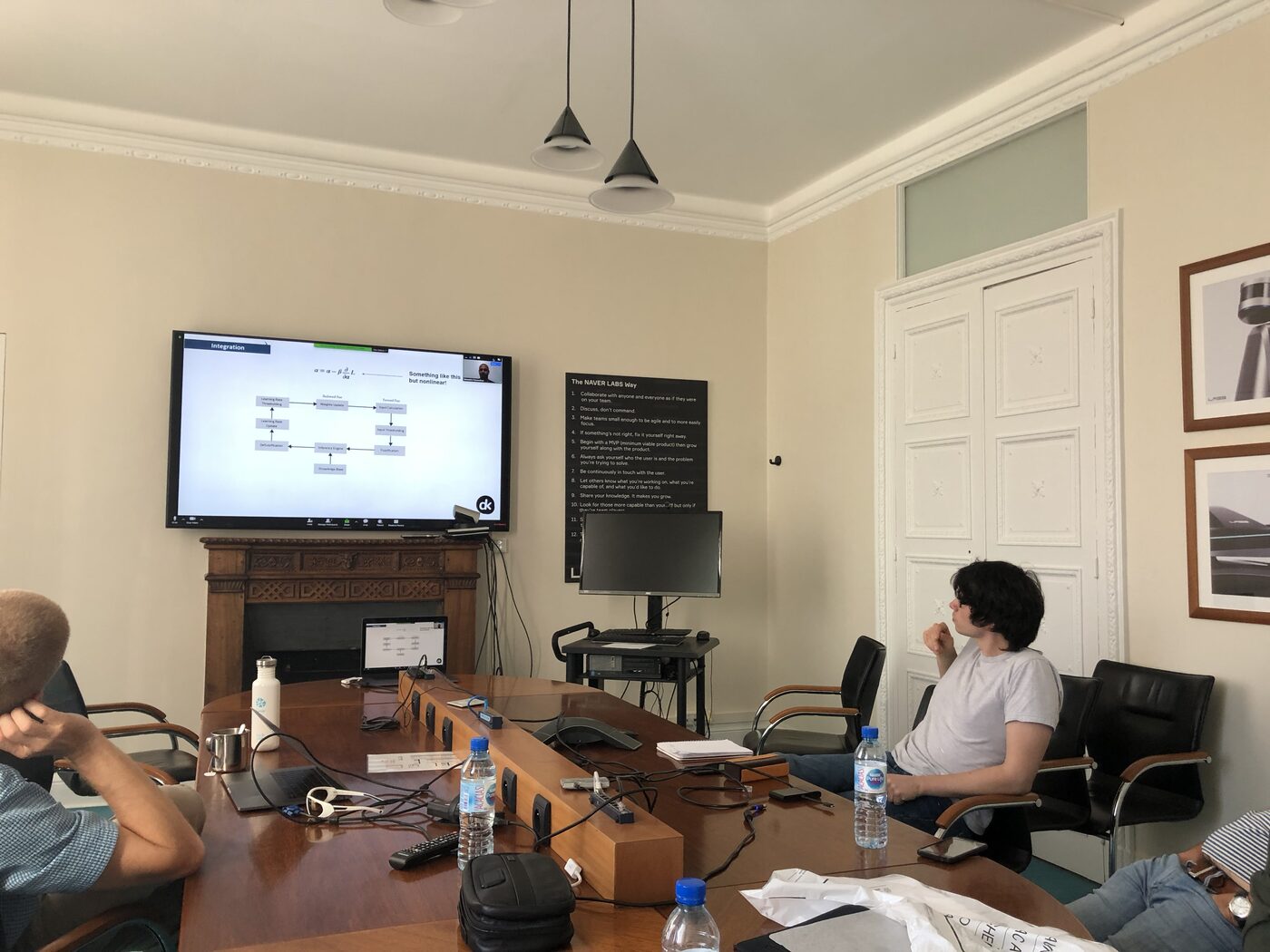
The second half introduced LAYGo, a method for setting the learning rate without hand-tuning. The framing was blunt about the state of practice: pick a value, watch the curve, pick another, and hope the schedule matches the assumption behind it. LAYGo replaces that loop with a fuzzy logic controller that reads the training signal and adjusts the rate, with a complexity reduction step to hold down the compute cost. The results slide compared it against a constant learning rate and a scheduled one on CIFAR-100. The closing slide set out where it was going: fuzzy logic and genetic algorithms combined to evolve a controller for any hyperparameter, plus a recursive gradient difference operator to cut the computation further.
The deck did not stop at benchmarks. One slide traced the same activation work through applied projects: IDH1 glioma classification on VGG16, brain tumour segmentation on UNet, genomics prediction with recurrent nets, and engagements with a global mobile manufacturer, a development bank and a German manufacturing client. The audience was small, a handful of researchers around one table rather than a lecture hall, which suits material that lives on the question of why a curve from 1959 botany should govern a neural network.
Client revenue figures from this session are not published.
Narendra Patwardhan, Madhura Ingalhalikar and Rahee Walambe, submitted 22 May 2018. The paper behind the first half of the session.
