Five plateaus, then a wishlist
A five-stage deep learning course for Nokia engineers, ending with hand-built TensorFlow networks and a flip chart of in-house AI projects the room claimed for itself.
deepkapha.ai ran a deep learning programme for Nokia in Finland across late February and early March 2018. The trip opened in central Helsinki on 24 February and ended at the airport on 3 March, taking in Nokia's Karaportti campus in Espoo on the afternoon of 2 March. No agenda or slide deck survives, so the shape of the course below is read off the teaching materials and the participants' own work rather than off a running order.
It was built in five stages, called Plateaus. Plateau 1 covered Python, statistics and mathematics. Plateau 2 was data analysis in NumPy, pandas, Matplotlib and Seaborn, worked through missing data, groupby, merges and file I/O on a salaries table and an e-commerce purchases table. Plateau 3 was machine learning: linear and logistic regression on the Titanic and advertising datasets, principal component analysis, decision trees and random forests on kyphosis and loan data. Plateau 4 was deep learning in TensorFlow, on Fashion-MNIST, CIFAR-10 and CIFAR-100. Plateau 5, an advanced AI masterclass, was on the plan, but no material from it survives and we do not claim it ran. The cohort also received a reference shelf: Bishop, Hastie and Tibshirani and Friedman, Goodfellow and Bengio and Courville, Kuhn and Johnson, ten cheat sheets, and two papers, Kingma and Ba on Adam and the Google Brain paper on Swish.
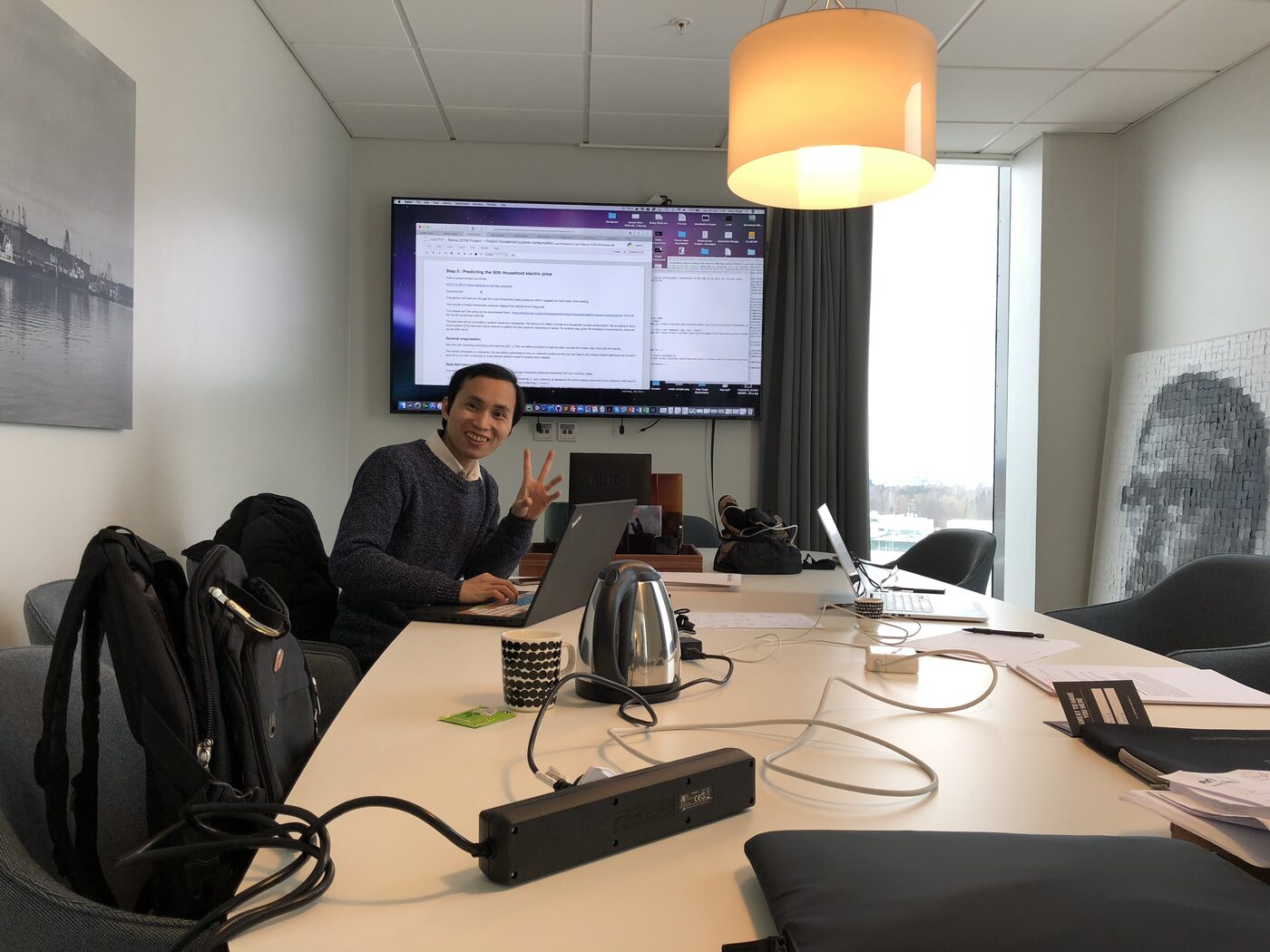
Three of the participants' notebooks show what they built. Each is a feedforward network written out by hand rather than assembled from a wrapper: weight and bias dictionaries, ReLU layers, softmax cross-entropy loss, the Adam optimiser, TensorBoard summaries wired in. The two trained on Fashion-MNIST reached 88.2 and 89.2 per cent test accuracy; the third, on MNIST digits, reached 93.5. One notebook still carries the proxy setting that put training behind the corporate network, so this ran on Nokia machines. A wall screen on 25 February showed the applied project being prepared, a notebook headed "Nokia LSTM Project: Predict Household's power consumption".
The same trip also carried a CNN and RNN workshop, the convolutional and recurrent sessions that Plateau 4 ran on. Which day it ran on is not recorded.
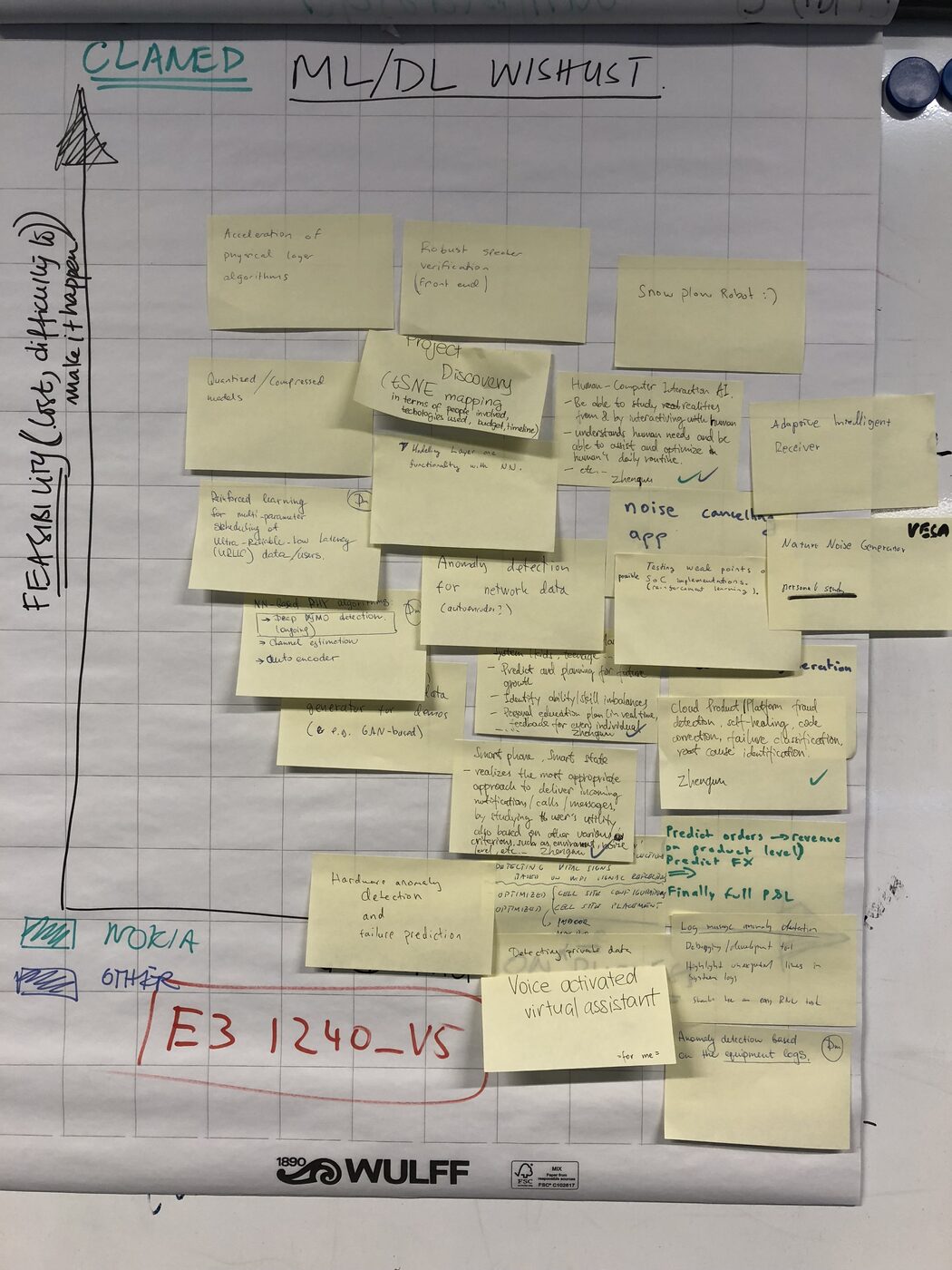
The week ended with a working session on the Espoo campus. A flip chart headed ML/DL WISHLIST maps sticky notes against feasibility and against how firmly each project had been claimed, split into a Nokia column and an other column. The notes are specific to the business: anomaly detection on network data with an autoencoder, hardware failure prediction, channel estimation, quantised and compressed models, reinforcement learning for scheduling on ultra-reliable low-latency links, speaker verification, an adaptive receiver, anomaly detection on log messages, cell-site configuration and placement. That board is the honest output of the engagement. The cohort left holding a list of their own problems they now believed they could model.