Berlin Bioinformatics Hackathon
A lecture on Geoffrey Hinton's newly released capsule networks, then a hands-on build classifying skin lesions with transfer learning in Keras.
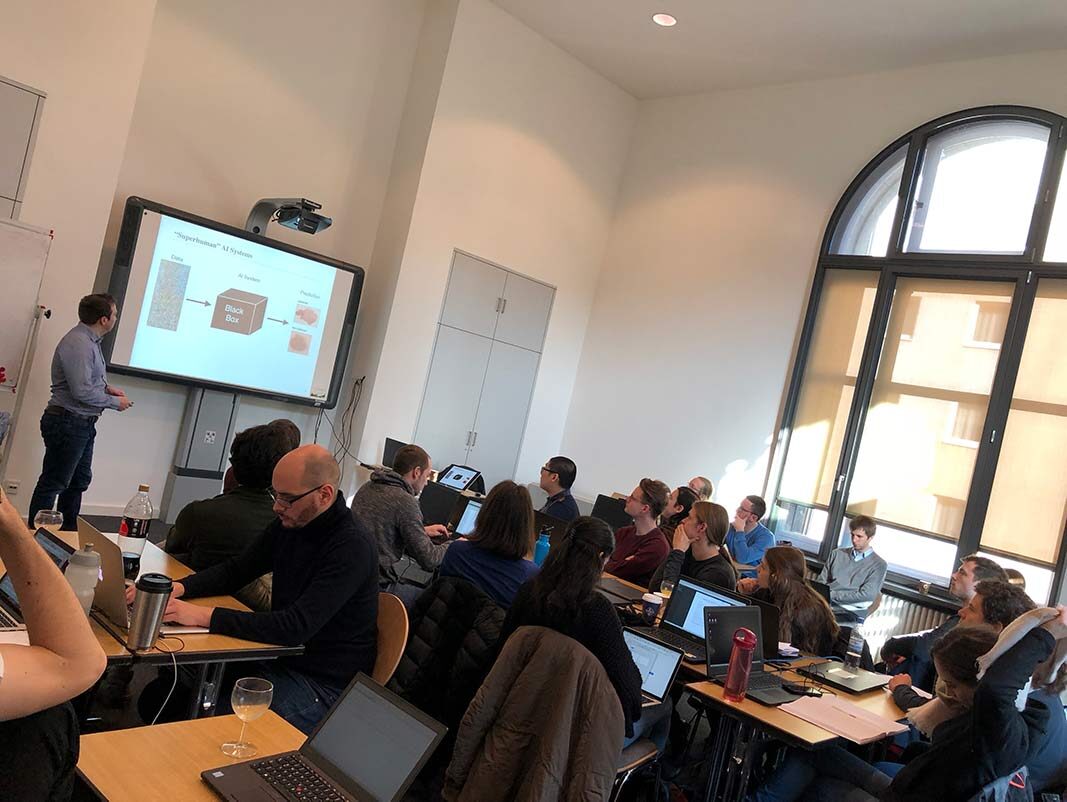
In this lecture we discussed the newly released capsule network by Geoffrey Hinton and his co-authors. Capsule networks were the new and shiny neural network architecture challenging CNNs, then the king of the hill in computer vision.
It was an overwhelming experience to have been invited by our newfound friends Mike Richardson, a leading hardware design engineer, and Julien Fredonie, later head of innovation at Honda. Both worked hard to make it a reality, and hundreds of people showed up. Capsule networks were new, and the implementation people were running had come from Huadong Liao, who worked with the lab. This was that work, taken to a room full of people.
The trip ran out of Assen on 7 February and came back from Deventer on 10 February. On the morning of Thursday the 8th an uberX carried Tarry from Knobelsdorffstraße in Charlottenburg across the city to Winsstraße in Prenzlauer Berg, picked up at 08:44 and set down at 09:11. The teaching slot sat inside the Berlin Bioinformatics Lectures series, under the deck title "Emerging Topics in Translational Bioinformatics".
The hands-on half was skin cancer classification across three classes: melanoma, nevus and seborrheic keratosis. It was pinned to a published result rather than a toy problem. Andre Esteva and colleagues had shown dermatologist-level classification of skin cancer with deep neural networks in Nature the year before, and the folder carries his deck alongside the reading around it. Data came from the ISIC Archive, with a downloader configured for 13,786 images. Participants built a small convolutional network from scratch first, three conv-and-pool blocks into a 512-unit dense layer and a three-way softmax, so the shape of the problem was clear before any shortcuts. Then transfer learning on InceptionV3 with ImageNet weights, the convolutional base frozen and a new head trained on top. Then fine-tuning, unfreezing from layer 339 with SGD at a learning rate of 0.00001. The homework was to ship it, rebuilding the classifier as an Android app with TensorFlow Lite or an iOS app with Core ML.
The setup meant building TensorFlow 1.5 and 1.6 from source with Bazel on Ubuntu, which is what installing a framework often meant in early 2018. The training box was one GeForce GTX 1080 with 7.93 GiB of memory.
The lecture is fixed to 8 February. The notebook's GPU log is dated a week later, so the build session may have run separately.
The deck used for this lecture.
