Climbing the deep learning hill in Chicago
Deep learning lectures at the University of Chicago, structured as a five-plateau climb from linear algebra to applied AI, closing on the lab's own research.
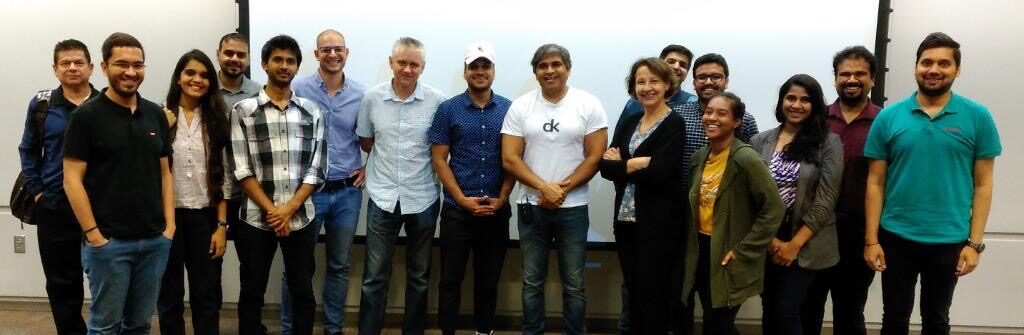
The deck opens on a meet and greet slide and its title reads "Deep learning lectures, University Chicago". Branded materials from the host, a tote bag and a tumbler carrying the university seal and the words Master of Science in Analytics, place the sessions with the analytics programme. The room was a standard teaching space with a projection screen, and around sixteen people in front of it.
The spine of the teaching was a map called Five Plateaus to Applied AI. Plateau one was fundamentals: linear algebra, matrices, probability theory, Bayes, kernel density estimation, the central limit theorem, and programming in Python, R and Julia. Plateau two was visualisation and numerical tooling. Plateau three was machine learning: regression, clustering, classification, ranking, feature extraction and dimensionality reduction. Plateau four was deep learning proper, with CNNs, RNNs, autoencoders, GANs, reinforcement learning, super resolution, object detection and capsule networks. Plateau five was applied AI, taught as a production loop running from business need through feature engineering, model training, evaluation, deployment and retraining, with cross validation, A/B testing and model management named as parts of the cycle rather than afterthoughts.
A long middle section grounded the theory in published healthcare work. It walked through convolutional networks classifying pulmonary tuberculosis from chest radiographs, published in Radiology in August 2017, and what that meant for regions short of radiologists. It covered skin cancer detection at the University of Queensland, where a CNN was trained on 30,000 histology slide images in around fifteen minutes on GPU hardware. It covered the NVIDIA and Canon Medical Systems partnership of April 2018. The section closed on ways into the field for the people in the room: the MURA musculoskeletal radiograph dataset and the Data Science Bowl.
The final third was the lab's own research, presented rather than summarised. One thread was work on intra-thalamic and thalamocortical connectivity, arguing from lateral geniculate and perigeniculate loops that the thalamus is not the passive relay centre it was long taken to be, with the implications drawn out for network topology. A second was ARiA, the Adaptive Richard's Curve Weighted Activation, which borrows a four-parameter growth function used in forestry, maize leaf area and predator-prey modelling and turns it into an activation function. ReLU and Swish fall out of it as special cases, and the two-parameter version, ARiA2, outperformed both across MNIST, CIFAR-10 and CIFAR-100 under varied architectures, depths, optimisers and batch sizes. A third was LAYGo, work on the learning rate as the hyperparameter that matters most, and on replacing repeated manual tuning with a controller. The deck names the team behind it, including Jie Mei on neuroscience and Narendra Patwardhan on robotics and AI.
The exact days are uncertain. Sources give 8 to 9 October and 9 to 10, so both are covered here.